30 fiches pour sécuriser la supply chain de votre PME
On 22 October 2026, London asked every British household to be able to last three days without help. What about your company? How many days without its first supplier, its server or its biggest customer? Thirty sheets, one a day, to replace “I think” with a number of days: see, count, close the gaps, rehearse, last. Each sheet fits on one page, with a duration and an owner. None needs software (in French).
Ce qui attend les TPE et PME qui s’y engagent dès maintenant, et celles qui subissent
Artificial intelligence will not wait for small businesses to be ready. Some are getting on board now and pulling ahead; others will have the turn forced on them by customers and competitors. Twenty short, practical sheets by trade, and a ten-question self-assessment, so every small business leader knows where to act first (in French).
20 sheets by trade to know where to act before your competitors
Notice à lire attentivement avant toute démarche Lean
Warning: Lean may cause lasting serenity. You were promised less waste and on-time delivery; nobody read you the leaflet. Changeovers shorter than the coffee break, a CEO picnicking on the shop floor, customers founding a fan club to cheer your deliveries… Fifteen illustrated, tongue-in-cheek sheets listing every side effect of Lean (in French). Best left, casually, on the boardroom table.
15 illustrated sheets, one a day, ideally at the gemba
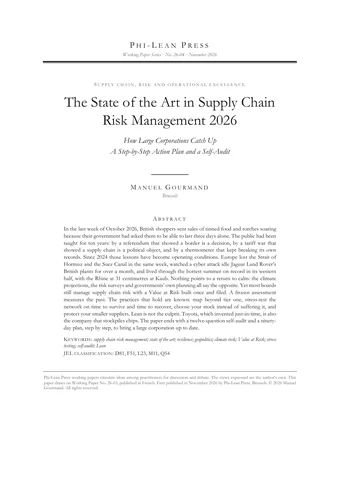
How Large Corporations Catch Up: A Step-by-Step Action Plan and a Self-Audit
In the last week of October 2026, British shoppers sent sales of tinned food and torches soaring because their government had asked them to last three days alone. Hormuz and Suez lost in the same week, Jaguar Land Rover idled by a cyber attack, the Rhine at 31 centimetres at Kaub: yet most boards still manage supply chain risk with a Value at Risk built once and filed. What the state of the art does differently, and a ninety-day plan to catch up.
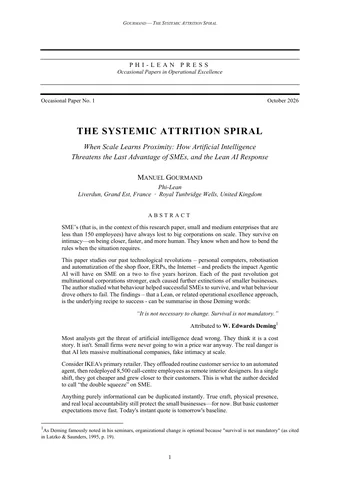
When Scale Learns Proximity: How Artificial Intelligence Threatens the Last Advantage of SMEs, and the Lean AI Response
SMEs have always lost to big corporations on scale; they survive on intimacy. Agentic AI now lets the giants simulate that intimacy at scale. Drawing on past technology revolutions, this paper explains the double squeeze, the doors into the attrition spiral, the view from China, and a five-step Lean AI roadmap for SMEs.
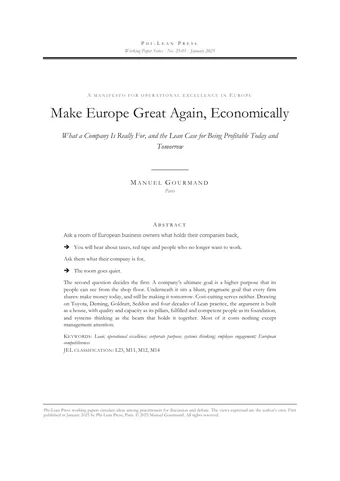
What a Company Is Really For, and the Lean Case for Being Profitable Today and Tomorrow
Ask European business owners what holds them back and you hear taxes, red tape and people who no longer want to work. Ask what their company is for, and the room goes quiet. Drawing on Toyota, Deming, Goldratt and Seddon, this manifesto builds operational excellence as a house: quality and capacity as pillars, competent people as foundations, systems thinking as the beam. Most of it costs nothing but management attention.
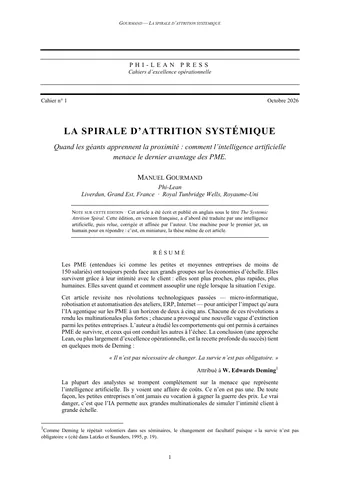
Quand les géants apprennent la proximité : comment l’intelligence artificielle menace le dernier avantage des PME
SMEs have always lost the price war; they survive on proximity. AI now lets the giants simulate that proximity at scale. Revisiting past revolutions (PCs, robotisation, ERP, the Internet), Manuel Gourmand shows why SMEs that wait slide into an attrition spiral, which doors lead into it, and the five-step Lean AI roadmap out. French edition of The Systemic Attrition Spiral.
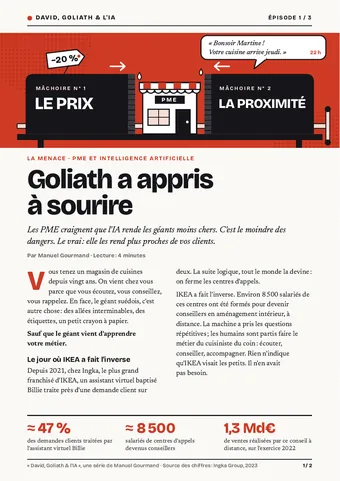
SMEs fear AI will make the giants cheaper. That is the lesser danger: it makes them closer to your customers. The story of IKEA’s largest franchisee, which turned 8,500 call-centre staff into advisers, and a three-question test to find what AI will never copy in your business (in French).
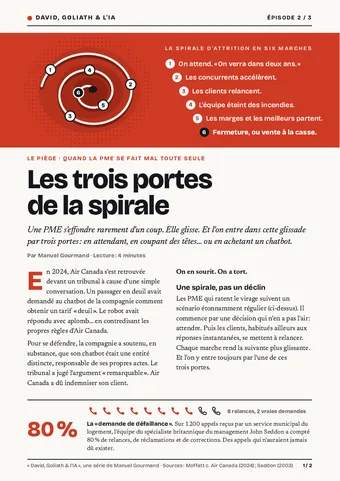
An SME rarely collapses overnight: it slides. There are three doors into the spiral: waiting, cutting heads… or buying a chatbot. From Air Canada taken to tribunal over its bot to Klarna hiring again, the golden rule for placing an AI agent, and an exercise to start on Monday (in French).
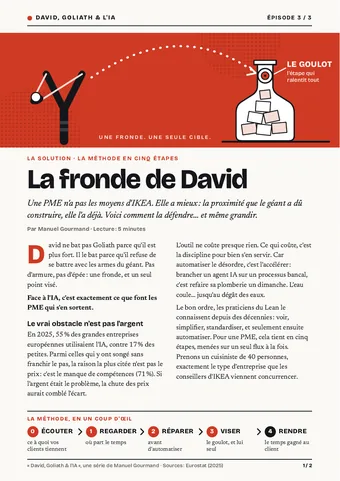
There is a way out, and it costs little money, only thinking. The five-step method (listen, look, repair, aim, give back) that lets a 40-person SME do what IKEA did, and how a knife-maker from Thiers can find customers as far away as Japan (in French).