The pillars: serve more, serve better
Lean Plant Flow
Lean applied to the plant, starting from value stream mapping: free up capacity without heavy investment, and get quality right first time.
The Phi-Lean house
A culture of operational excellence, built with your teams.
Cutting costs is not enough: your income must grow faster than your expenses. Phi-Lean helps you get there, from the plant to the supply chain.
Explore the house, part by part
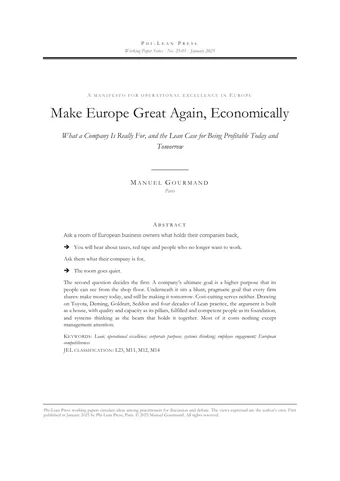
The Phi-Lean house is developed in the manifesto Make Europe Great Again, Economically (PDF, 8 pages)
The house and its sources (PDF in French, 2 pages)
The house, from the foundation up
The foundation
The part executives skip because it sounds soft. It is the hardest part of the house: engaged teams who set their own working standards, have the skills to improve the work and can talk things through when the stakes are high. They are the ones who bring costs down for good, not the cuts.
Sources : Devine (2023); Grenny et al. (2022)
The levers
Serve more: extra capacity without heavy investment, by reorganising the flow of information and product. Serve better: added value and quality right first time, with no rework. Either way, lower cost is a consequence, never the target.
Sources : Capacity: Bicheno & Holweg (2016); quality: Deming (1986)
The method
The system governs performance. You design it from customer demand and flow, rather than through command and control. Improving one pillar in isolation simply moves the problem next door: you redesign the system, with the people who run it.
Sources : Seddon (2003)
The result
Instead of shrinking its expenses, a company must grow its income faster than its expenses. Profitable today is easy; profitable today and tomorrow is a discipline.
Sources : Goldratt & Cox (1984)
The direction
Above the roof, the reason for being: it holds steady while strategies change, and it is built with the teams, concrete enough for everyone to see it from their workstation. The loop back to the foundation is the reminder: it is the teams who get you there.
Sources : Collins & Porras (1996); Devine (2023)
Each element of the house rests on established work: seven books and articles, cited in APA style (7th edition). Click an element for the full analysis and what we do with it in our work.
Collins, J. C., & Porras, J. I. (1996). Building your company’s vision. Harvard Business Review, 74(5), 65–77.
A lasting vision rests on a core ideology, values and purpose, that stays stable while strategies evolve.
Devine, F. (2023). Rapid mass engagement: Driving continuous improvement through employee culture creation. McGraw Hill.
A Higher Purpose, built with the teams, speeds up engagement and culture change.
Goldratt, E. M., & Cox, J. (1984). The goal: A process of ongoing improvement. North River Press.
The goal of a company: to make money, today and tomorrow.
Seddon, J. (2003). Freedom from command and control: A better way to make the work work. Vanguard Education.
Design the organisation as a system, from customer demand and flow, rather than through command and control.
Bicheno, J., & Holweg, M. (2016). The lean toolbox: A handbook for lean transformation (5th ed.). PICSIE Books.
The lean toolbox: flow, capacity and variability management, waste reduction.
Deming, W. E. (1986). Out of the crisis. MIT Center for Advanced Engineering Study.
Deming’s chain reaction: improving quality lowers costs, raises productivity and wins the market.
Devine, F. (2023). Rapid mass engagement (see above).
Engaged teams who create their own standards of behaviour.
Grenny, J., Patterson, K., McMillan, R., Switzler, A., & Gregory, E. (2022). Crucial conversations: Tools for talking when stakes are high (3rd ed.). McGraw Hill.
Holding the conversation when the stakes are high, emotions run strong and opinions differ.
Six ways to work on the house, always on the ground and with your teams, from SMEs to large groups.
The pillars: serve more, serve better
Lean applied to the plant, starting from value stream mapping: free up capacity without heavy investment, and get quality right first time.
The pillars, in the office
For service businesses and support functions: measure failure demand (chasers, re-keying, complaints), shorten customer lead time, automate only in the right place.
The beam: the end-to-end flow
The same view beyond your walls, from suppliers to customers: pull flows between sites and warehouses, properly sized safety stock, an S&OP that works.
The roof: the “tomorrow”
Know how many days you can last if your first supplier stops, and close the gaps that matter. One offer for SMEs, one for large groups.
The foundation and the direction
Hands-on training and serious games for teams, and a crisis management exercise designed for leadership teams.
When you need someone, now
A site, supply chain, maintenance or operations leadership role to cover for a few months: Manuel Gourmand steps in and leaves an organisation that holds.
Three days on site, one value stream mapped with your teams, a costed 90-day action plan. Fixed fee of €2,900 excl. VAT, deductible from the engagement that follows.

Founder of Phi-Lean · ENIM engineer · MSc Lean Enterprise, University of Buckingham
An ENIM engineer with an MSc in Lean Enterprise from the University of Buckingham (Distinction), Manuel Gourmand spent fifteen years running industrial operations and supply chains in France, the UK, the Netherlands, Brazil and the United States. He ran a production site with full P&L responsibility, led the start-up of a new plant in the Netherlands and coordinated a group’s distribution through eleven regional hubs. He founded Phi-Lean to put that experience to work for business leaders, from SMEs to large groups.
15
years running plants and supply chains, in five countries
+14 %
EBITDA in two years at the last site he ran, without heavy investment
75 → 98 %
on-time service at that same site, with the average selling price up 22%
189 M$
of revenue served by the distribution supply chain he coordinated (11 hubs)
« The software costs almost nothing. The discipline to implement it well is what costs: not in money, but in thinking. »
Working Paper No. 25-01 · January 2025 · 8 pages
Why the question “what is your company for?” decides everything else.
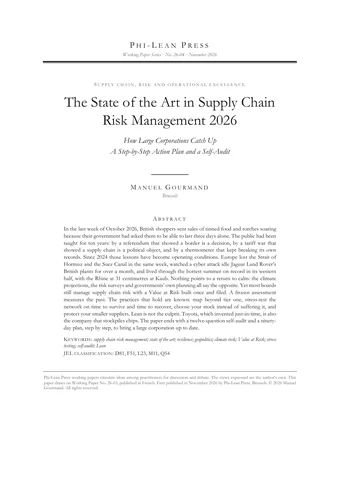
Working Paper No. 26-04 · November 2026 · 13 pages
Ten years and one summer: how 2025 and 2026 turned known risks into operating conditions.
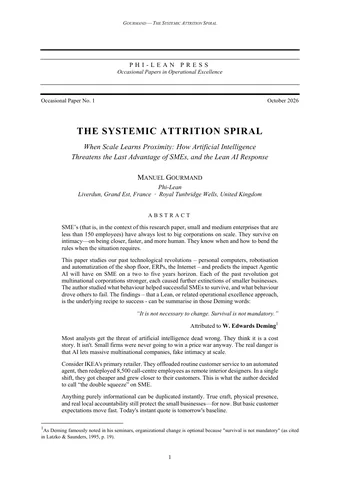
Occasional Papers in Operational Excellence, No. 1 · October 2026 · 25 pages
Why the threat is proximity, not cost.
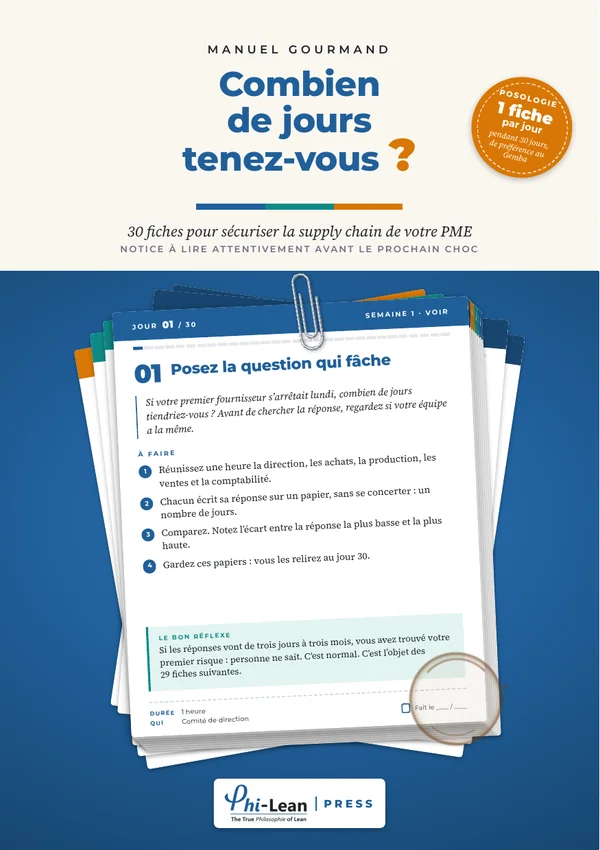
Free e-book · November 2026 · 37 pages · in French
Thirty one-page sheets, one a day, each with a duration, an owner and four concrete actions.
A conversation with Manuel Gourmand, by video or phone, to understand your situation and see together whether a diagnostic makes sense.